The Schomburg Center in 3 Short Stories
Ai Onubogu | Rutgers University | April 2024
These last few weeks at the Schomburg have been a whirlwind as we all continue to work on building our digital database. Three particular scenes keep arising from my memory. These are less ‘discoveries’ per se, but moments in my memory where I grew curious about the pathways for coalition between black women writers.
A Story:
During the last two weeks, we have shifted from entering Broadside works to working on the Jean Yellin and Cynthia Bond’s bibliographic list, The Pen Is Ours: A Listing of Writings by and about African-American Women before 1910 with Secondary Bibliography to the Present. One work I found particularly interesting was not my own, but another fellow’s. She was working on Memoirs of Elleanor Eldridge and, sitting across from me, was excited to show me that there were multiple editions across multiple works. We also noticed that there was a library checkout card at the front of the book stamped for the Alumnae of the Lincoln School for Nurses. After I googled it (I was curious if this was a hospital that solely trained and served the black community–it was not–), we learned that Nella Larsen was a graduate of this school. I was curious about the relationship between ‘helping professions’ and writing. For instance, how might Larsen’s formal training shaped her writing, if at all? In thinking about this relationship between ‘helping professions’ and writing, many women writers often oscillate between the two; however, this may be purely because women are often imagined as innate nurturers and encouraged to pursue such careers. By and large, I was really struck by this possible connection between Eldridge and Larsen.
Another Story:
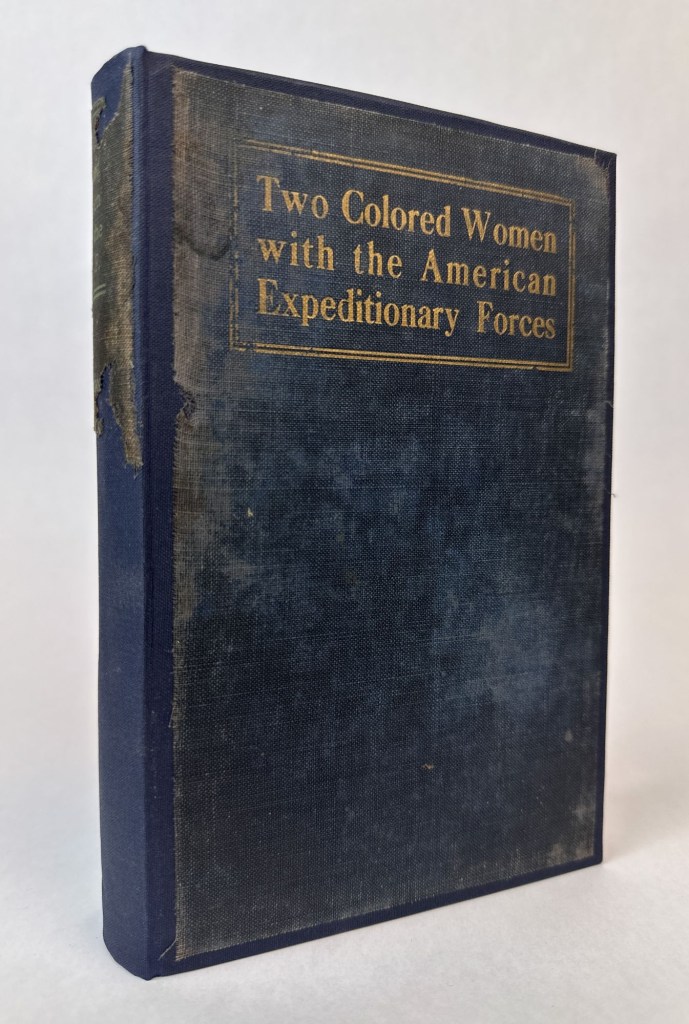
Another curious find! At the end of the last day I worked in July, I was working on Two Colored Women with the American Expeditionary Forces by Addie W. Hunton and Kathryn M. Johnson. At the front of this copy, there was a newspaper article–taped and folded to fit inside the front cover of the book–featuring a (mostly positive) book review. It was warming to see the weathered but well-preserved interjection of the newspaper clipping, like a signature of its own. It seemed to mark the interest of connecting the text with the public life of the text, of maintaining a record that is not purely the physical record substantiated by the book itself. It also could have been just a happy reminder to the authors as they celebrated their work and commemorated a positive reception.
A Sub-Story of Another Story:
The article included in the Hunton and Johnson book I’ve just mentioned was published by The Brooklyn Eagle which shares a name with the text’s publisher, Brooklyn Eagle Press. It made me curious if there was any relationship between the two. While I unfortunately could not determine what or if there was a connection between the two, this possibility laid a seed for thinking in my mind. More generally, this made me wonder about what the relationship between the book publishing press and newspapers are. I suppose they are not so far off from one another at all, but, until I saw the twin Brooklyn Eagles I never considered that related presses would use different mediums to push the same product. I look forward to learning more about this in the future!
Works Cited
Eldridge, Elleanor and Frances H. Green. Memoirs of Elleanor Eldridge. Providence: B.T. Albro, 1846. Schomburg Sc-Rare B-Eldridge, Archives and Rare Books Division, Schomburg Center for Research in Black Culture, The New York Public Library.
Eldridge, Elleanor and Frances H. Green. Memoirs of Elleanor Eldridge. Providence: B.T. Albro, 1847. Schomburg Sc-Rare B-Eldridge, Archives and Rare Books Division, Schomburg Center for Research in Black Culture, The New York Public Library.
Hunton, Addie W. Two colored women with the American Expeditionary Forces. Brooklyn, New York : Brooklyn Eagle Press, 1920. Research & Reference Division, Schomburg Center for Research in Black Culture, The New York Public Library.

This license enables reusers to copy and distribute the material in any medium or format in unadapted form only, for noncommercial purposes only, and only so long as attribution is given to the creator.
Subscribe
Enter your email below to receive updates.
 The Black Bibliograpy Project