Reflection on the first BBP Wikidata Edit-a-thon
Jeania Ree Moore | Yale University | February 2024
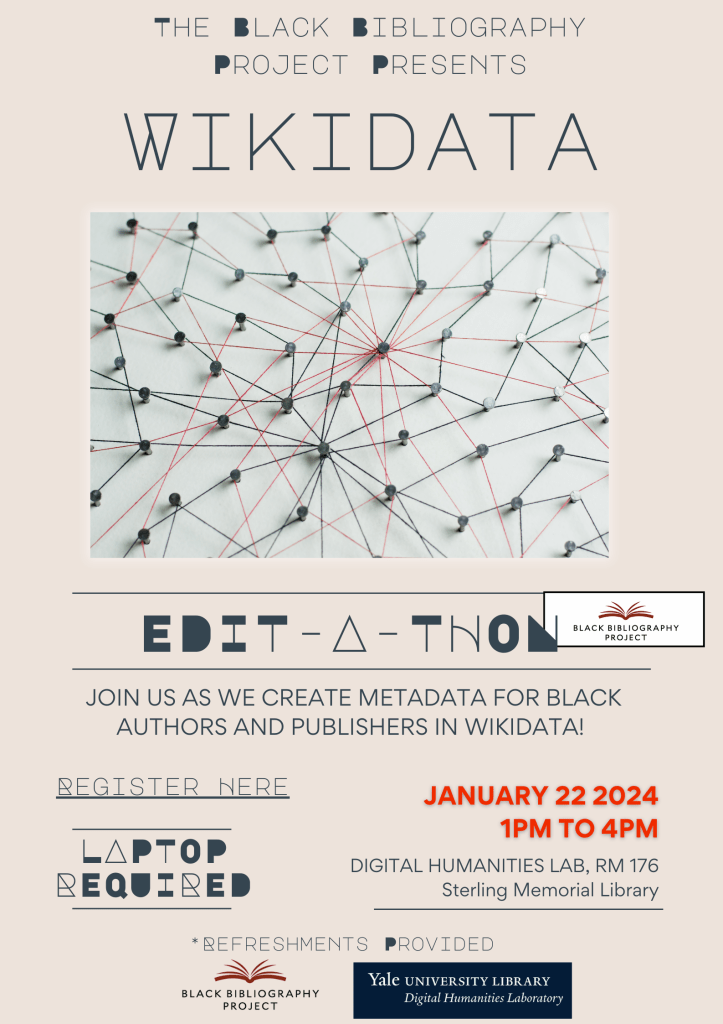
Last week we had our first BBP Wikidata Edit-a-thon in the Digital Humanities Lab at Sterling Memorial Library. I went in not knowing what to expect. Having been introduced to wiki building and interfacing solely from our BBP website training last summer, I was curious about how this differed from and connected to what we do on a day-to-day basis. I also, admittedly, wondered how much I would be able to actually learn and implement in the span of an afternoon workshop.
When I arrived at the DH Lab, the first thing I noticed was the set-up. Multiple chairs were placed at the tables, which formed a loose horseshoe shape facing each other and the screen. And what’s more—and was a welcome sight on a Monday afternoon—a room stocked with coffee, tea, and snacks was provided for us just off to the side.
The second thing I noticed was who else was arriving to participate. A mix of students and what appeared to be library staff soon filled the chairs around me. When I asked my desk partner where they hailed from in the university, they responded that they were a data librarian in the medical school who had learned about the event from Yale University Library’s DEIA email uplifting events related to the university’s weeks-long MLK Jr. Day commemoration. By the time the workshop started, the room was a buzzing cross-section of various parts of the university that don’t normally interact, especially on research projects working in a manner where everyone—undergraduates, graduate students, faculty, staff—is doing the same thing, rather than separate, specialized, and, often, hierarchized tasks.
As explained in the opening orientation, our task for the afternoon was creating the background data that populates pages in Wikidata, a platform used by Wikipedia as well as Google (in those nifty data sidebars). Whereas our day-to-day tasks with the BBP are bibliographical, focused on creating bibliographic data supporting texts in the BBP database, our work that day in the Wikidata Edit-a-thon was biographical.
We were creating and filling in data points for people that did not yet exist in the massive Wikidata database, or who existed but whose record lacked information. These people are writers, scholars, authors, activists, printers, publishers, newspaper editors, and more—all connected in some way with the Black texts that are the focus of the BBP.
Over the course of the event, I realized that the learning curve was way less steep than I anticipated. And I discovered that our learning not only built on itself, but also built on and encouraged the nascent community in the room. In its accessibility, its critical engagement, and its communal setting, the entire event reinscribed the ethics and collaborative infrastructure of the BBP in new ways.
In terms of access, the Wikidata Edit-a-thon was much more open physically and technically (“know-how”) than most archivally-related research I have encountered. Anyone could just wander in and join us for a couple hours or thirty minutes, and see the impact they were making. It’s not often that a highly theoretical, conceptually sophisticated research project is so on-the-ground and open to people at all stages to contribute, make a difference, and see that difference in real time. We could easily create a person and add to the vast knowledge enterprise of Wikidata, redressing gaps and adding details that facilitated other connections. For instance, in the process of creating a data point for historian Bernice Forrest, I also corrected the record for the writer whose works she edited, her great-grandmother, nineteenth-century poet Olivia Ward Bush-Banks.

I edited Bush-Banks’ Wikidata page to more accurately record her ethnic heritage as not just African American but also Indigenous American and specifically Montaukett—details that were missing in the prior entry and a fact that matters, especially given that Bush-Banks served as historian for the Montaukett tribe. Previously, had someone done a search in Wikipedia for Montaukett individuals or writers, neither Bush-Banks nor Forrest would have appeared; now, they both will. It’s something small that yet feels significant, in its personal meaning and connection. (If you’re interested, you can read more about Forrest and Bush-Banks here).

The reduced barriers to participation did not mean ours was not a critical task. As participants, we found ourselves in frequent conversation with our desk partners and others around the room, raising questions and crowdsourcing answers on how to address tough situations of categorization and data description. It’s one thing to read about and analyze critiques of the politics of cataloguing, archival data, and historical language; it’s another thing to face the challenge and try to tackle the task of recuperating knowledge and intervening in historical memory to populate a database. One document whose related biographical data I wrestled with inputting was a slave narrative that was also a gallows statement from four enslaved people who were executed for homicides in Missouri. How do we list these individuals? What biographical data is knowable about them? How do we record and wrestle with the limits of knowing, related to this document? It was good to be in community in that work of trying to figure out answers to these questions
Lastly, and relatedly, the nature of the space and work drove home the collective responsibility of the task of knowledge creation. This struck me as both an epistemological meta-commentary on the BBP itself and an actual reality shaping us in that workshop. The physical set-up of the room encouraged conviviality, conversation, movement, and exchange—so different from most archive reading room experiences I have had where the spatial and acoustic arrangement seems to emphasize that the work of knowing is silent, solitary, and absolutely no food allowed! Humor aside, the practical nature of this collective responsibility was one of the biggest takeaways from the Wikidata Edit-a-thon. If we weren’t already, that day we became Wikidata contributors! As someone who had always wondered about but been more than a little intimidated by the prospect of becoming a Wikipedia contributor, I found this super cool. And it was even cooler to leave with confidence in a role that had mystified me.
Empowerment from community is what the BBP is about: bringing to light the vast community of actors in relation to Black books and texts. Our work in the Wikidata Edit-a-thon was a different but no less impactful angle on that same yield.
Works Cited
Henderson, Madison, et al. Confessions of Madison Henderson, Alias Blanchard, Alfred Amos Warrick, James W. Seward, and Charles Brown, Murderers of Jesse Baker and Jacob Weaver, As Given by Themselves: and a Likeness of Each, Taken In Jail Shortly After Their Arrest. Crime, Punishment, and Popular Culture, 1790-1920. [Place of publication not identified]: [publisher not identified], 1841
Scott, Ivy. “Roots Reconnected.” Brown Alumni Magazine, 21 Jun. 2022, http://www.brownalumnimagazine.com/articles/2022-06-21/roots-reconnected. Accessed 22 Jan. 2024.
Wikipedia, Olivia Ward Bush-Banks. https://en.wikipedia.org/wiki/Olivia_Ward_Bush-Banks
This license enables reusers to copy and distribute the material in any medium or format in unadapted form only, for noncommercial purposes only, and only so long as attribution is given to the creator.
Subscribe
Enter your email below to receive updates.
 The Black Bibliograpy Project