Reflections on Nigerian Market Literature in the Black Bibliography Project
Thobile Ndimande | Yale University | September 2025
In Summer 2025, Ndimande curated an exhibition of Nigerian Market Literature at Yale University Libraries titled “Street Talk.”
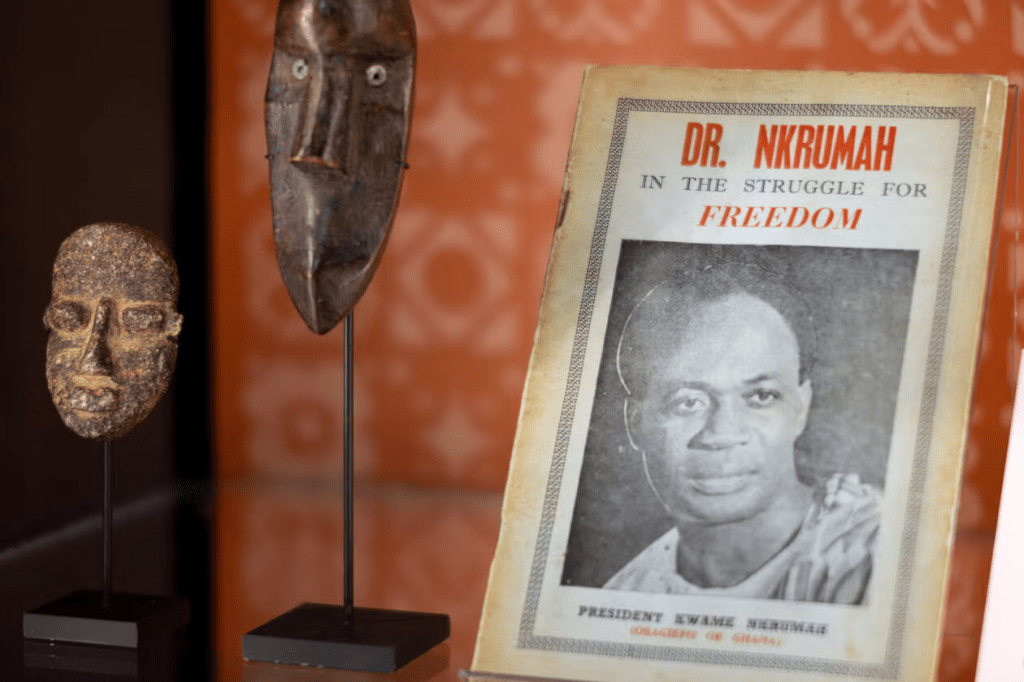
The names of New York based bookseller, Kurt Thometz, Yale Africana Librarian, Moore J. Crossey and LIbrarian and Bibliographer, Dorothy Wesley Porter – all come together through Onitsha Market Literature collection at Yale University.
Kurt Thometz considers himself a private librarian though he can be better understood as a bookseller. He came into the business in the 1970s at a time when there was a growing institutionalisation of scholarship focused on Black people from and beyond America. One can imagine stepping into Thometz personal collection and finding James Baldwin, Chinua Achebe and maybe less popular on this side of the Atlantic as in comparison to the busy bustling streets of Onitsha an author by the pen name “Strong Man with the Pen” aka Olisah Okenwa.
Around this very period Moore J. Crossey sat as Yale’s Africana Curator/Librarian who happened to go on an exchange fellowship program that landed him at the University of Ibadan, Nigeria. Crossey came to know and see for himself the self-made publishing and printing presses which were in turn the bookshops the very pamphlets would be distributed from. Having been affiliated with the early stages of the African Literatures Association which published meeting minutes under the Africana Librarian Newsletter, Crossey together with other affiliates organised towards creating repositories of African material with the intention to preserve and utilise for research.
When I first searched for Onitsha Market Literature with the hopes of paging through the pamphlets I had, thanks to Quicksearch and my inexperience of navigating the catalogue, I pulled out a box of Dorothy W. Porter’s correspondence and a version of Onitsha Literature printed in a journal. I figured she knew about this buzz and wanted it recorded even if she did not have the pamphlets themselves – a variant of what they could offer was good enough.
I recognize and call on the Black Bibliography Project to see together with me the efforts on the part of the bookseller, librarian and bibliographer to draw a connection. This connection may not be at the level of Blackness but it is historical and geographical. I say this because the various gestures made by these actors show that there was a sense of bringing into the fold a transnational dimension to the politics and structures of knowledge production for future engagement.
I consider what is African and of Africa to be Black. This position must not be confused with one that universalizes the experience of Blackness because specificity is subject to time and space. I would like for the Black Bibliography Project to engage the question in a self-reflexive manner where relation and positionality are in constant communication with one another. Specific to the Onitsha Market Literature which in its name calls onto the specificity of location – a place Southeast of the Niger River in Nigeria.
This literature as noted in a number of prefaces of the pamphlets, while produced in this specific location, imagined itself as read across the world. This declaration of global orientation can at times be taken for granted given the site of production of the material, where a text assumes to take on a global audience without needing to declare it. While at the same time the contents of the text can be encrypted and open only to a particular [Black diasporic] audience. Overall, I am of the view that relationality and positionality should play a fundamental role in how Blackness is understood when it comes to the conceptual understanding of the Onitsha Market Literature fitting into the Black Bibliography Project.
Works Cited
- Allie Barton, Image of Nkrumah Pamphlet Cover, 2025, Photograph, “Street Talk: Exhibition explores the literary pulse of early post-colonial Nigeria,” https://news.yale.edu/2025/05/13/street-talk-exhibition-explores-literary-pulse-early-post-colonial-nigeria. ↩︎

This license enables reusers to copy and distribute the material in any medium or format in unadapted form only, for noncommercial purposes only, and only so long as attribution is given to the creator.
 The Black Bibliograpy Project