Anthologies and Black Queer Community Building
Christopher Valentine | May 2025 | Yale University
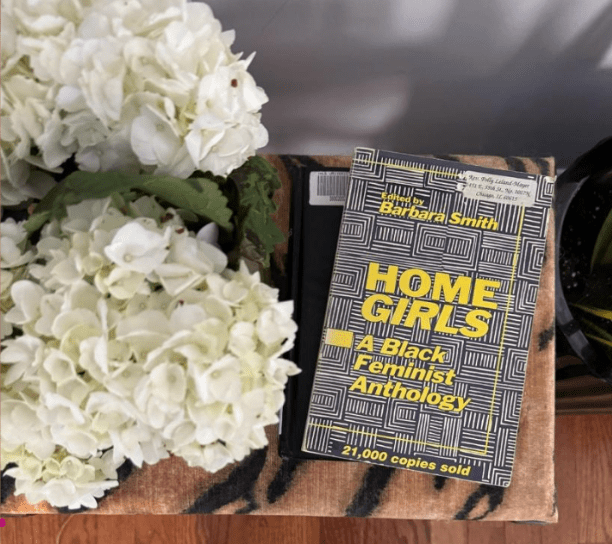
One of my many reasons for wanting to participate in the Black Bibliography Project (BBP) was the potential to work closely with anthological objects. In my own research, I’ve been fascinated by the ways black lesbian feminists and black gay men were utilizing the genre to announce themselves and
their communities especially during the long-1980s. I jumped at the chance to work on a copy of Kitchen Table Press’s Home Girls: A Black Feminist Anthology (1983) edited by Barbara Smith located at Sterling Memorial Library here at Yale.ii
In Home Girls and other anthologies from the same period I’ve been curious about the inclusion of biographical notes sections that list short overviews of each contributor’s background as well as print history. I haven’t encountered enough anthologies yet to know if this is a particularly black practice, but it nonetheless strikes me as an invaluable tool not only to bring visibility to marginalized people, but it opens a crucial site through which to trace genealogies of print. Certainly, it was helpful for me as I began the work of inputting individual writers into the BBP’s database. One great example is the writer Shirley O. Steele, who contributed the short story “Shoes Are Made for Walking” (Steele 260). I failed to find a Library of Congress number for her or a Wiki data entry which struck me as particularly strange given that her biographical note in Home Girls portrayed her as an active black feminist writer and editor. The short biographical entry stated that she and seven other women published an anthology titled Gap Tooth Girlfriends: An Anthology (1981).iii I circled back to the Home Girls bio page again and found that three of its contributors Alexis De Veaux, Jewelle Gomez, and Donna Allegra are all also noted to have contributed to Gap Tooth Girlfriends.
After a google deep dive, I came across an interview that Jewelle Gomez did with Black Women Radicals and she just so happened to briefly mention Gap Tooth Girlfriends and how it came into being. In the interview, Gomez reveals that the project began as a 10-woman writing workshop that then blossomed into a book project. Each member sold pre-orders of the book within their community in New York City, used those funds to pay a lesbian printer, and then distributed the completed books to the community that helped make it possible.
It is so rewarding that I get to help create a starting point for people to learn more about women like Shirley Steele. It’s also gratifying for me just to have the opportunity to meaningfully think about how an anthology comes into to being from a material standpoint as a literally representation and gift to a specific black community. I see the contributor’s bio section in Home Girls to be doing something similar to the aims of the BBP as it makes it possible to locate people, communities, and the work that they did together. I never did find Shirley Steele on the internet and perhaps that’s the way she wants it. I did however add her as “human” to the Black Bibliography Project’s database. The contributor’s bio in Home Girls says that at the time of publication Steele was “working on a Black love story and enjoying the summer immensely (Steele 375).” Perhaps through the BBP someone might pick up where I left off. Even if you fail to locate Shirley herself you might just stumble upon her Black love story.
i In the picture that I’ve included you can see that the Yale Library copy which is a first edition first printing on the bottom has just a plain black cover which I suspect might be a library binding. On top, you can see the copy from my own personal collection which is a first edition fourth printing. Not to ramble on for too long but I’m nerding out a bit about the fact that that I get to be a little piece of this copy’s provenance. There is a sticker on the cover of my copy that tells me that the book was the property of Rev. Polly Leland Mayer in Chicago IL. Meanwhile I picked up this gem from rare Black bookseller Rosa Duffy in Atlanta, Ga in 2020.
ii Smith, Barbara, ed. 1983. Home Girls: A Black Feminist Anthology. 1st ed. New York: Kitchen Table– Women of Color Press. QID: 7873 iii De Veaux, Alexis, and Shirley O. Steele, eds. 1981. Gap Tooth Girlfriends: An Anthology. Bronx, New York: Gap Tooth Girlfriends Publications.
 The Black Bibliograpy Project